Customize the Kitchen
A collection of small kitchen CAD / 3D printing projects to make our lives easier.
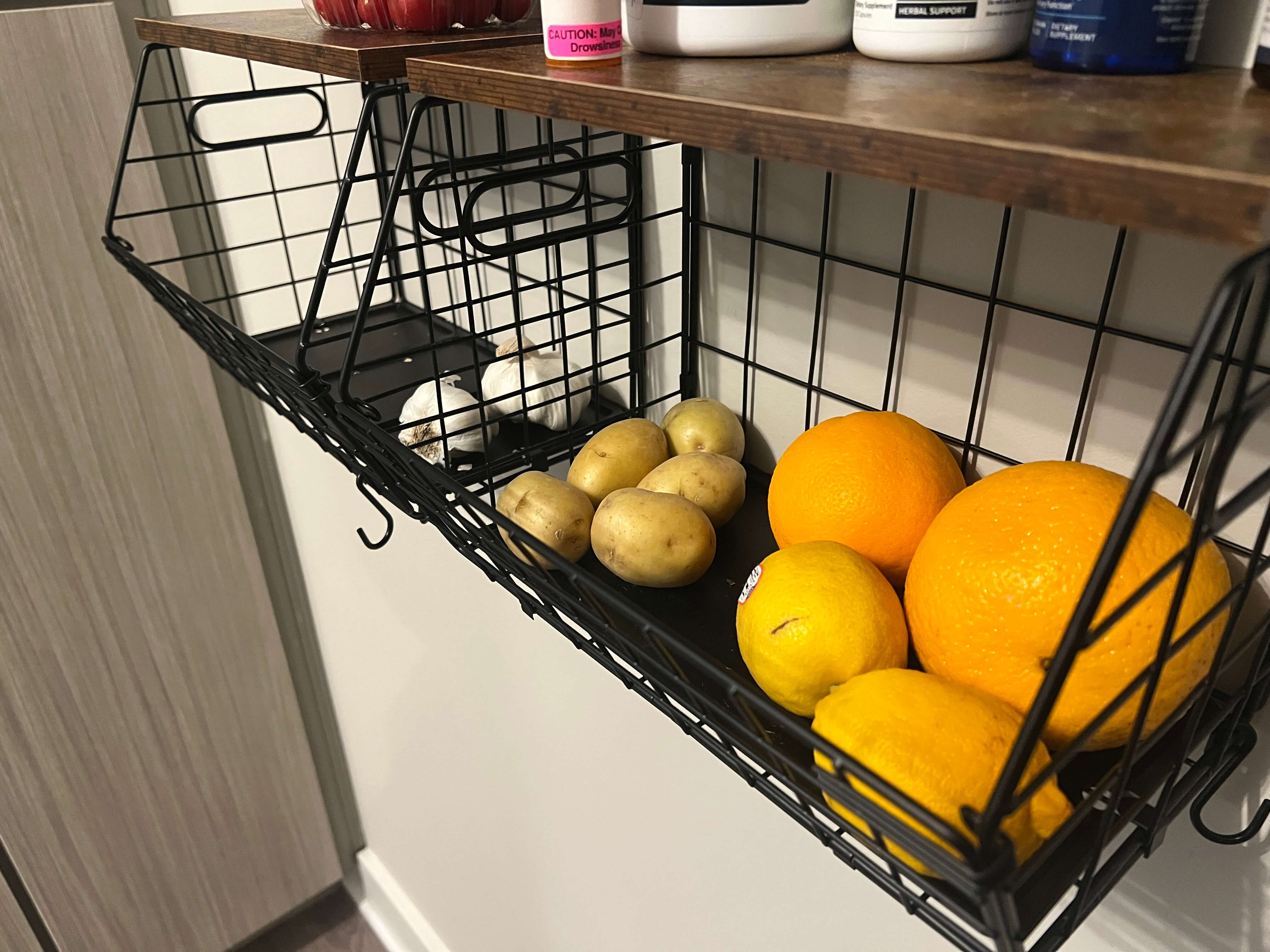
A lot of my smaller design work starts with a simple pattern: my girlfriend notices something in our kitchen that’s frustrating or inefficient, and I take that as an engineering problem to solve. Living in a small apartment forces everything to be space-efficient and intentional, which makes it a perfect environment for highly targeted, custom solutions.
One example is a set of wall-mounted metal fruit baskets we use for storage. The baskets have a grated metal bottom, which turns out to be a problem for softer fruits—anything stacked or resting on the grid tends to bruise over time. To solve this, I designed and printed a custom-fit tray that drops into the existing rack. It conforms to the geometry of the basket, including cutouts for mounting tabs, and replaces the harsh metal surface with a smooth, food-safe platform.
Another, more involved project was a fully custom spice drawer system. With a large and constantly growing collection of spices, storing everything in a single shallow drawer quickly became chaotic. I designed a set of four nested, size-specific racks that fit precisely within the drawer’s dimensions. Each spice bottle sits in an individual recessed well, allowing for extremely dense packing while still keeping everything visible and accessible.
Getting the spice system right required a few iterations. Early versions had wells that were too shallow, allowing bottles to shift out of place. Later, I introduced angled geometry so that when the drawer opens or closes—often with a noticeable jolt—the bottles naturally settle back into position rather than sliding around. The final result is a stable, high-density storage system tailored exactly to our usage patterns.
These projects aren’t about novelty—they’re about precision. By measuring, modeling, and fabricating each solution myself, I can produce tools that fit our exact constraints in a way off-the-shelf products never quite do. It’s a practical application of CAD and rapid prototyping, focused entirely on removing small but persistent sources of friction from everyday life.